
FAQ
Frequently Asked Questions
Straight answers about the Functional Extremities approach, FEA, the FE Method and enrollment.
The Functional Approach
A Functional Lens for the Musculoskeletal System
What is Functional Extremities?
Professional clinical education that gives clinicians an additional functional lens for evaluating the entire musculoskeletal system. Structured extremity assessments help identify potential functional weak links that might otherwise go unrecognized, connect regional findings, and reassess whether an intervention has produced a meaningful change.
Is it an extremity-adjusting program?
Not simply. Functional Extremities is not a collection of orthopedic conditions, isolated muscle tests or extra adjustments. It is a systematic way to evaluate how extremity function relates to the broader musculoskeletal system. The goal is not simply to treat more joints. It is to evaluate the system more completely.
Does it replace my spinal, orthopedic or neurologic exam?
No. It is designed to complement established spinal, orthopedic, neurologic and biomechanical assessment. We are upgrading the clinical lens, not replacing the clinician’s existing knowledge.
What is a functional weak link?
A functional deficiency in one region that may contribute to altered loading, compensatory movement or increased mechanical demands elsewhere in the kinetic chain. Identifying one provides additional clinical information. It does not, on its own, establish the underlying cause.
What is a home-base assessment?
A regional reference assessment. The hip serves as the home-base reference in the lower extremity and the glenohumeral region in the upper extremity, giving consistent points of comparison as additional regions are evaluated.
Is muscle testing a diagnosis?
No. A manual muscle test may provide clinically useful information, but it does not independently establish a specific structural lesion, neurologic diagnosis or cause of symptoms. Findings are read alongside your history, examination and clinical judgment.
Where does the spine fit?
The spine remains an important structural and neurologic foundation. Functional Extremities connects spinal knowledge with a more comprehensive functional evaluation of the extremities. It does not assume every extremity weakness originates from the spine, or that spinal adjustment is always required.
What regions and joints are covered?
Lower extremity: hip, knee, ankle, subtalar joint, medial arch and lateral arch. Upper extremity: glenohumeral, sternoclavicular, acromioclavicular, humeroulnar, proximal radioulnar and wrist/carpal.
The Programs
Two Educational Applications
What are FEA and the FE Method?
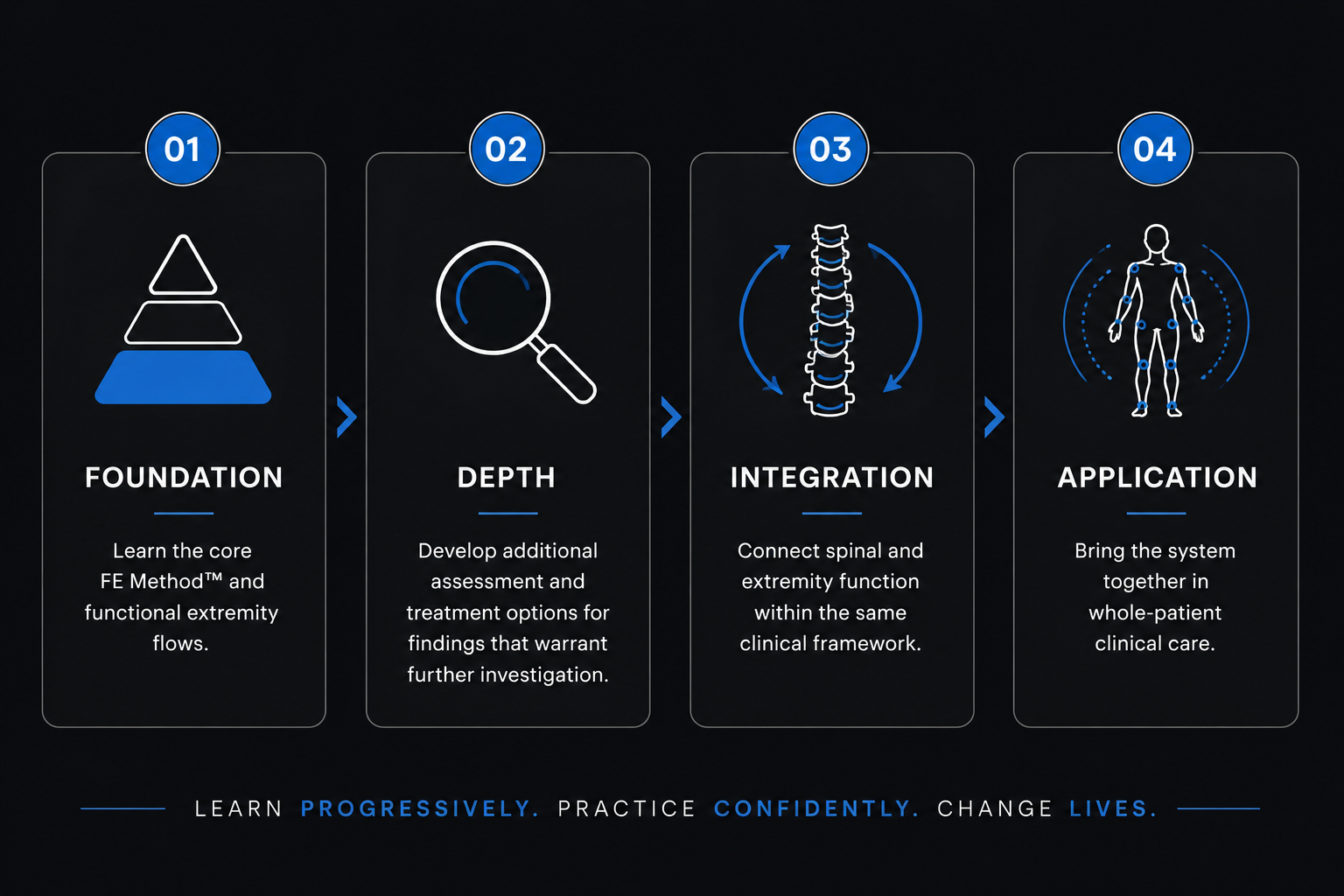
Two separate, standalone programs built on the same functional system. FEA (Functional Extremities Assessment) teaches the assessment framework: Assess Function. Connect the Findings. The FE Method (Functional Extremities Method) teaches the clinical application: Assess Function. Treat With Purpose.
Who is FEA for?
Chiropractors, physical therapists, osteopathic practitioners and other qualified musculoskeletal professionals. FEA focuses on assessment, interpretation and clinical reasoning, not treatment techniques, and its spinal foundation component is conceptual.
Who is the FE Method for?
It is developed primarily for chiropractors and includes extremity-specific chiropractic adjustments, reassessment procedures, soft-tissue considerations, spinal relationships and clinical troubleshooting. Other qualified musculoskeletal practitioners may apply relevant assessment, soft-tissue, rehabilitation and clinical decision-making principles within their professional scope of practice.
Do I need FEA before the FE Method?
No. The FE Method contains brief FEA assessment recaps, so students are not required to purchase FEA separately.
How is each FE Method lesson structured?
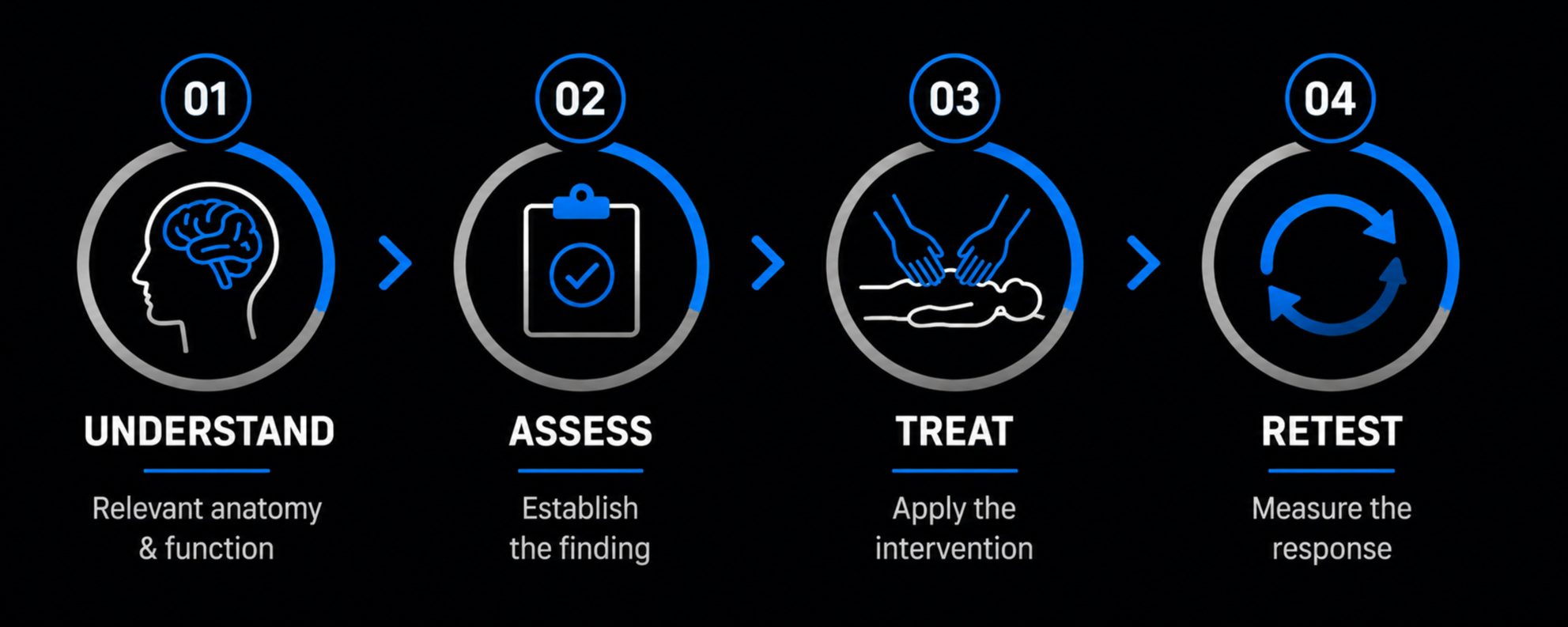
Assessment, clinical decision, correction, reassessment and troubleshooting. When a finding persists, clinicians may investigate relevant soft-tissue, spinal, regional, neurologic or other contributors, and further evaluation or referral may be appropriate.
Can I start with FEA and upgrade to the FE Method later?
Yes. If you enroll in FEA first, part of your FEA tuition is credited toward the FE Method when you upgrade within 12 months of enrolling in FEA. Pricing hasn’t been announced yet.
I took FEC. How is the FE Method different?
FEC established the foundation. The FE Method refines the process, with a consistent five-step lesson structure, complete clinical flows and a structured troubleshooting pathway.
Enrollment
Enrollment, Community and CE
When can I enroll?
Both programs are in development and enrollment isn’t open yet. Join the interest list and we’ll let you know when each one opens.
What will it cost?
Pricing and payment options for FEA and the FE Method haven’t been announced yet. We’ll share them when enrollment opens.
Is there a certification?
Certification is coming in the future. Details haven’t been announced yet.
Do I get CE credit?
Not at this time.
I’m a current FEC member. Where do I log in?
Use Log In to reach your existing courses and community access.
Still Have a Question?
Join the Functional Extremities interest list and we’ll let you know when enrollment opens for FEA and the FE Method.
Functional Extremities provides education for licensed healthcare professionals. Apply what you learn within your scope of practice and the regulations where you practice. Course content is not a substitute for clinical judgment, diagnosis or referral.